Application of DL-Tartaric acid for food
November 02, 2026
DL‑Tartaric Acid (racemic, CAS 133‑37‑9) is a versatile, cost‑effective acidulant used across food and beverage manufacturing where strong acidity, pH control, and chelation are required — but optical purity (chirality) is not critical.
Key Food Applications (with Typical Use Levels)
A. Beverages (Carbonated & Still)
Function: Acidulant, flavor enhancer, preservative aid
Use level: 0.1–0.5% (w/w)
Why: Clean sourness without masking delicate flavors; synergistic with ascorbic acid in fortified drinks
Note: DL‑tartaric is less expensive than L‑tartaric — ideal for high‑volume soft drinks, energy drinks, and powdered beverage mixes
B. Confectionery (Gummies, Hard Candies, Sour Sanding)
Function: Sour coating, acidulant, texture aid
Use level: 0.5–2.0% (higher in sour sanding: 5–10% blended with citric/malic acid)
Why: Tartaric acid’s lingering sourness complements fruit flavors; acts as a setting aid in pectin‑based gummies
C. Baking Powder & Instant Mixes
Function: Leavening acid component
Use level: 15–30% of total baking powder formulation (blended with monocalcium phosphate, sodium acid pyrophosphate, etc.)
Why: Provides delayed CO₂ release when combined with sodium bicarbonate; stable in dry mixes
D. Effervescent Tablets & Powders (Nutraceutical / Hydration)
Function: Acid component for effervescence
Use level: 20–40% of tablet mass
Why: Reacts with NaHCO₃ to produce CO₂; DL‑form is economical for large‑scale production
E. Dairy & Plant‑Based Alternatives
Function: pH adjustment, calcium chelation
Use level: 0.05–0.2%
Why: Prevents protein aggregation in UHT milk, cheese, and plant milks; improves texture and stability
F. Canned & Bottled Vegetables / Fruits
Function: Acidifier, firming aid
Use level: 0.1–0.3%
Why: Lowers pH for microbial safety; chelates metal ions from processing equipment that could cause discoloration
G. Wine & Fermented Beverages (Limited / Regional)
Important: In many jurisdictions, DL‑tartaric acid is NOT permitted in wine (EU, US, etc.) — only L‑(+)-tartaric acid (CAS 87‑69‑4) from natural grape sources is allowed.
Exception: Some countries permit DL‑tartaric in fruit wines, cider, or mead — always verify local regulations.
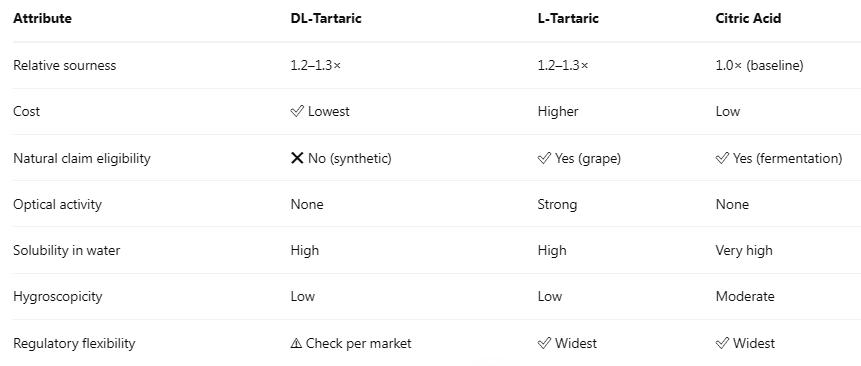
3. Advantages of DL‑Tartaric Acid (vs. L‑Tartaric & Citric)